
Out 15 October 2026 · in French
La finance digitale en Afrique francophone
Digital finance in French-speaking Africa: fundamentals and ecosystem
22 markets · 3 monetary architectures · one analytical framework.
Request a translation →About the book
The book is written in French. This page is for English-speaking readers who need a reliable map of the region: investors, development partners, researchers, companies entering the market.
A fintech launching in Kinshasa, another expanding from Dakar to Douala, a foreign player preparing its entry into French-speaking Africa: the regulatory, competitive and historical information they need exists, but it is scattered across twenty-two jurisdictions and rarely consolidated, while the abundant literature is written in English, from Kenya, Nigeria or South Africa.
Those who train and those who fund hit the same wall. Universities have books on banking and on insurance, but none on digital finance in French-speaking Africa, even as a generation of graduates and entrepreneurs is entering the sector today. As for the investors, incubators and accelerators multiplying across the region, they work from industry reports built at continental scale, in which French-speaking Africa fits on a single line.
This book brings that material together for the twenty-two markets of French-speaking sub-Saharan Africa, drawing on regulatory texts, institutional publications and the critical reading of practising professionals. It covers the sector’s trajectory since 1960, the three monetary architectures and their ten central banks, the regulatory frameworks of the three zones, the seven families of players and the six revenue lines, including float income. It addresses a blind spot, the telecom regulator, a precondition for the rise of mobile payments. And it gives the real state of financial inclusion, behind the published rates.
Back-cover text, translated from French.
Read the excerpt on L’Harmattan’s website (in French) →Contents
Nine chapters and a glossary
Chapter 1 Trajectory: how the ecosystem was builtp. 19
“What we observe in 2026 is the result of sixty years of layering: colonial banks, crises and privatisations, informal transfers, early regulatory frictions, the rollout of e-money, the arrival of fintechs.” — p. 19
Chapter 2 Monetary and institutional geographyp. 55
“The CFA franc is not one currency: it is two currencies, managed by two central banks, cleared by two card switches, supervised by two separate banking commissions.” — p. 55
Chapter 3 Regulatory frameworksp. 113
“The first mistake a practitioner trained in Europe makes when analysing fintech regulation in French-speaking sub-Saharan Africa is to look for PSD2. It does not exist.” — p. 113
Chapter 4 Public foundations: identity, data, shared infrastructurep. 175
“Shared instant payment rails are under active construction in WAEMU, further behind in CEMAC, and non-existent as regional infrastructure in most of the independent markets.” — p. 175
Chapter 5 Ecosystem playersp. 211
“Confusion about the players is one of the most costly in the ecosystem.” — p. 211
Chapter 6 Payment infrastructurep. 263
“The gap between the time of the promise and the time of settlement is the fundamental property to understand before analysing any payment infrastructure.” — p. 263
Chapter 7 Business models and revenue streamsp. 331
“An issuing bank, an e-money operator, a B2B fintech and a regional switch do not make their living the same way — even when they nominally take part in the same transaction.” — p. 331
Chapter 8 Financial inclusionp. 375
“These figures are real. They are not the whole reality.” — p. 375
Chapter 9 Conclusion and synthesisp. 433
“For the reader in a hurry, this is where to start; for the methodical reader, this is where to come back.” — p. 433
Glossary Technical terms used in the volumep. 443
“The definitions are operational, calibrated on how practitioners in French-speaking sub-Saharan Africa use the terms.” — p. 443
Quotations translated from French.
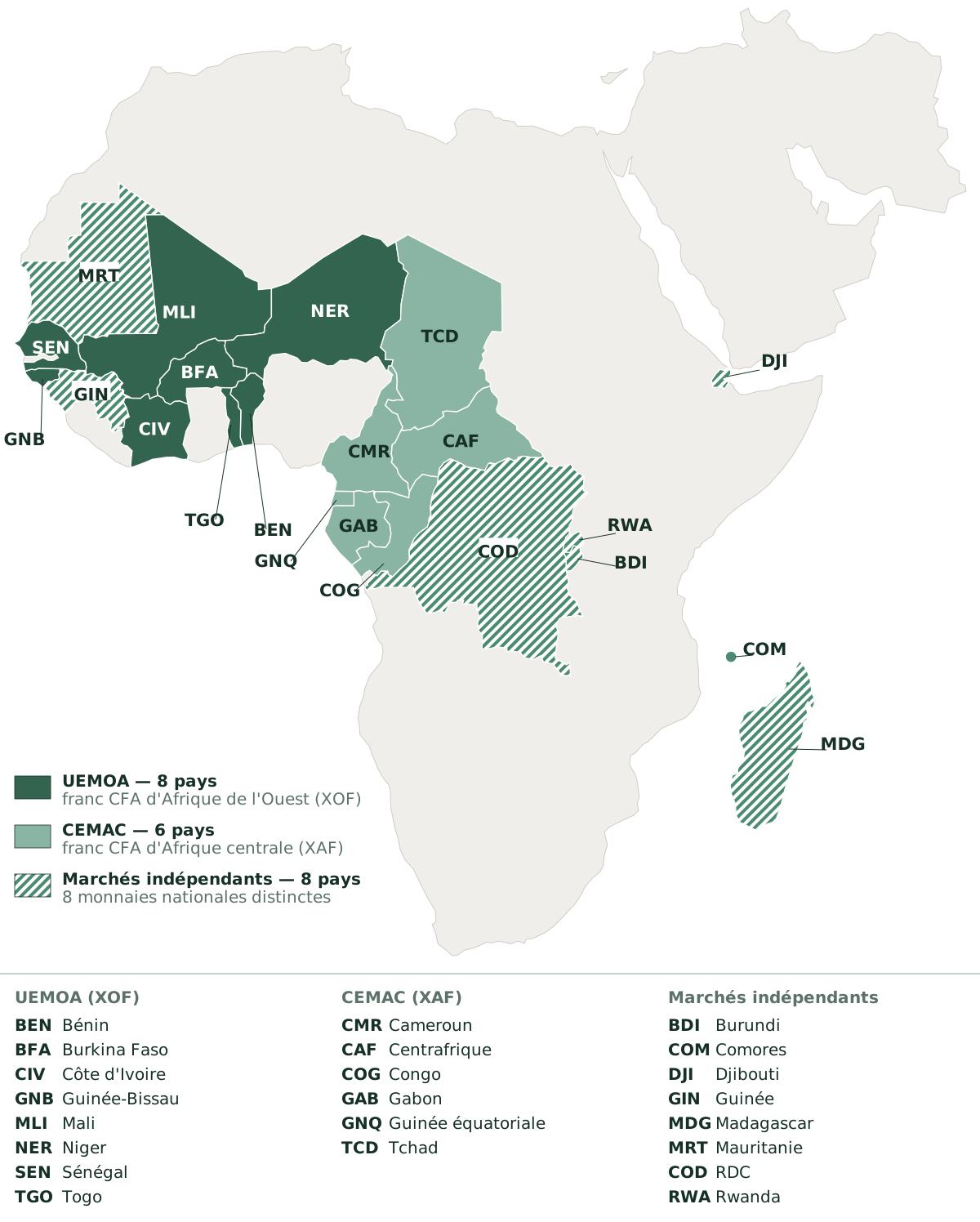
A figure from the book
Twenty-two countries, three monetary blocs: not one market
“A transfer from Abidjan to Douala […] costs more and takes longer than a transfer from Abidjan to Paris.”Chapter 2, p. 55
“WAEMU and CEMAC share surface monetary mechanics (fixed peg to the euro, convertibility guarantee) but diverge deeply in execution […].”Chapter 2, p. 66
“The practitioner’s rule follows: never infer how one zone works from the other.”Chapter 2, p. 66
Where to buy
Paperback or e-book
Paperback · 496 pp.
E-book
In French-speaking Africa: the list of bookshops carrying the book will be published here.
ISBN 978-2-336-65035-7 · Bulk orders (training, libraries, teams): contact@financedigitale-afrique.com
Translation
Would you read it in another language?
The book is available in French only. If you would read it in another language, say which one and how you would use it. Each request is read by the author and helps establish whether a translation is worth pursuing, and into which language. Translation rights are managed by the publisher, L’Harmattan. No commitment on either side.
Corrections and contributions to the book, in English or French: contributions@financedigitale-afrique.com
Get updates
Revisions of volume 1, the release of volumes 2 and 3. Nothing else.
You will receive a confirmation email. One-click unsubscribe. Privacy
The author
Jean M. Yenga
Jean M. Yenga has worked for more than twenty years on payments and electronic money in French-speaking Africa. He started in 2004 at MTN Cameroon, as head of information systems security at the time electronic money was launched.
He then moved into enterprise information systems: Oracle from 2013 to 2018, notably for the public sector in West Africa, then SAP and Atos, working with banks, telecom operators and public administrations. From 2021, he led fintech and digital partnerships at Visa across seventeen markets in West and Central Africa.
This path shaped the book’s thesis: the same payment solution does not deploy the same way in Dakar, Douala and Kinshasa. He lives and works in Abidjan. La finance digitale en Afrique francophone is the first volume of a series of three.
Talks, training, bulk orders: contact@financedigitale-afrique.com